
Μάθημα : ΑΓΓΛΙΚΑ Γ΄ΓΥΜΝΑΣΙΟΥ
Κωδικός : 0501447126
Unit 1 What a wonderful world
Holidays
In this Pre-intermediate Vocabulary Lesson about Holidays, you will learn essential terms and phrases related to holidays. The pictures, descriptions, and examples below will help you understand and remember the terms.
Nouns

1 A journey is the act of travelling from one place to another on a plane, bus, car, etc.
- The journey to my grandmother’s house took three hours by car.
2 A trip usually implies a short visit where you go somewhere, stay for a while, and then return—for example, a weekend trip to a nearby city. A trip generally includes two journeys (going to the destination and returning).
- We went on a trip to the beach for the weekend and had a great time.
3 A tour is a planned visit to see interesting places.
- We took a tour of the city and saw many famous landmarks.
4 A guide is a person who shows you around and gives information.
- Our guide told us many interesting facts about the ancient ruins.
5 Nightlife is entertainment and activities available at night.
-
The city’s nightlife is vibrant, with bars, clubs, and live music venues.
6 A museum is a place where you can see art, history, or science items.
- We went to the museum to see dinosaur bones and ancient artefacts.
7 A historical building is an old building that is important because of its past.
- The old castle is a historical building that is visited by many tourists.
8 A monument is a structure built to remember a person or event.
- The statue in the park is a monument to the famous writer.
Verbs and verb phrases

Types of accommodation

Tourism

Verbs and idioms

Adjectives to describe places

Present simple – Form

The spelling of he/she/it
The spelling of he/she/it is different in the present simple. Check how it changes below. The spelling is the same for all the other persons.

Present simple – Use
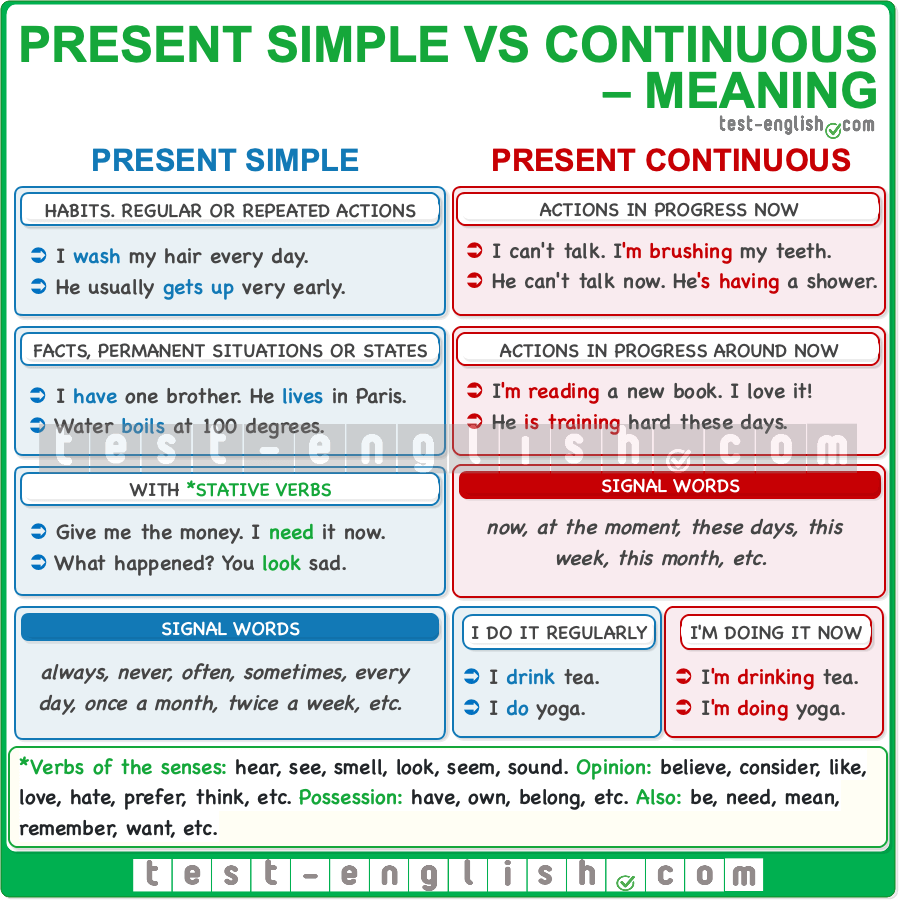
Habits or situations that happen regularly
We use the present simple for actions that we do (or we don’t do) regularly:
- I wash my hair every day.
- I never go to the library.
- I sometimes go to the library.
Permanent situations or things that are usually or often true
- I don’t drink coffee.
- She’s very tall.
- I have two brothers.
- Water boils at 100 degrees.
- I like soup.
Adverbs of frequency
We often use the present simple with adverbs of frequency (always, sometimes, etc.) and expressions of frequency (once every three months, twice a week, every other day, etc.).
Adverbs of frequency go in mid position (before the main verb or after be).
- She doesn’t often eat hamburgers.
- He usually gets up very early.
- I am never late.
Expressions of frequency go at the end of the sentence
- We go to the cinema once a month.
- I buy clothes twice a year.
Present continuous – Form and spelling

Present continuous – Use
Actions in progress
We use the present continuous to talk about things that are happening now or ‘around now’ (a time around this moment, such as these days, weeks or months)
- I can’t talk now. I’m brushing my teeth.
- I finished the Lord of the Rings and now I’m reading a new book.
Temporary actions
The present continuous is used for temporary actions:
- I’m going to work by bus this week because my car is at the garage.
- I’m living with my cousins temporarily.
With expressions meaning ‘now’ or ‘around now’.
The present continuous often appears next to expressions such as now, these days, this week/month, or at the moment.
- He’s studying a lot this week.
- I’m not feeling very well these days.
Stative verbs
Non–action verbs (or stative verbs) cannot be used in the present continuous. They must be used in the present simple. The most frequent are the verbs of the senses (hear, see, smell, etc. ), verbs of opinion (believe, consider, like, love, hate, prefer, think, etc.), and other verbs like be, have, need, want, etc.
- Please, give me my money; I need it now.
- Look at her; she seems sad.
Present simple vs present continuous
Past simple – Form

Spelling of regular verbs

Past simple – Use
Completed actions in the past
We use the past simple to talk about actions or events that happened in the past. We know, or we say, when the events happened.
- I saw Jim yesterday.
- We didn’t go out last Saturday. We stayed at home.
- She moved to Chester three years ago.
Past habits
We use the past simple to talk about past habits (things that we did more or less often).
- She washed her hair every day.
- She worked as a nurse.
- I often played in the park when we were children.
Situations that were true in the past
We also use the past simple to talk about things that were true in the past.
- My grandfather had two brothers.
- He lived with my grandparents as a child.
Events in chronological order
We use the past simple to describe the main events of a story in chronological order.
- When I arrived home, I took off my shoes and then I relaxed on the sofa.
The past continuous – Form

The past continuous – Use
Actions in progress
We use the past continuous to talk about actions that were in progress (not finished) at a specific moment in the past.
- ‘What were you doing at 9?’ ‘I was studying.’
- When I saw them yesterday, they were arguing.
The specific moment in the past can be described by a time expression (at 9 a.m., at midday, at lunchtime, all morning, all day, etc.):
- They were swimming at 7 in the morning.
- At midday, they were still working.
Or by a simple past sentence:
- They were swimming when I saw them.
- When she arrived, they were still working.
Describing a scene
We often use the past continuous at the beginning of a story to describe the situation.
- It was getting dark, and I was walking fast. Suddenly …
Past simple vs Past continuous
We use the past simple for completed actions in the past, and we use the past continuous for actions in progress (not finished) in the past.
- We ate out yesterday. (the action is finished)
- We were eating at 9. (the action was not finished)
The past continuous describes a longer action or situation, and the past simple describes a shorter action or event.
- When I met Susan, she was having a drink at a terrace with a friend.
- We didn’t go out because it was raining.
The short action in past simple often interrupts the longer action in past continuous.
- He was playing football when he broke his arm.
- When I went to bed, it was raining.
We use the past simple for completed actions that happened one after the other. Compare:
-
- When he arrived, she was having a shower. (The action of having a shower started before he arrived)
-
- When he arrived, she had a shower. (The action of having a shower started after he arrived)